LoRaWAN Energy Budget for Stratospheric Operations
🎧 Listen to this article: NotebookLM Podcast
An AI-generated audio discussion created by Google’s NotebookLM
LoRaWAN Energy Budget for Stratospheric Operations
The cascading power architecture defines how much energy is available at each temperature regime. But knowing what’s available is only half the equation—we must also understand how much energy each transmission costs to intelligently adapt the firmware strategy.
This post connects the LoRaWAN RF parameters to the temperature-dependent power delivery capability, answering the critical question: Which spreading factor and payload size can we actually use at -60°C?
The Energy Equation
A LoRaWAN transmission’s energy cost depends on three factors:
$ E_{tx} = P_{tx} \times t_{airtime} = (V \times I) \times t_{airtime} $
Where:
- V = Supply voltage (3.3V for the STM32WLE5 radio)
- I = PA current draw (varies with TX power setting)
- t_airtime = On-air time (determined by SF, bandwidth, and payload size)
For the Stratosonde at +14 dBm (US915 legal limit):
- Voltage: 3.3V
- Current: 26 mA
- Power: 85.8 mW
The variable is airtime—and it varies enormously with spreading factor.
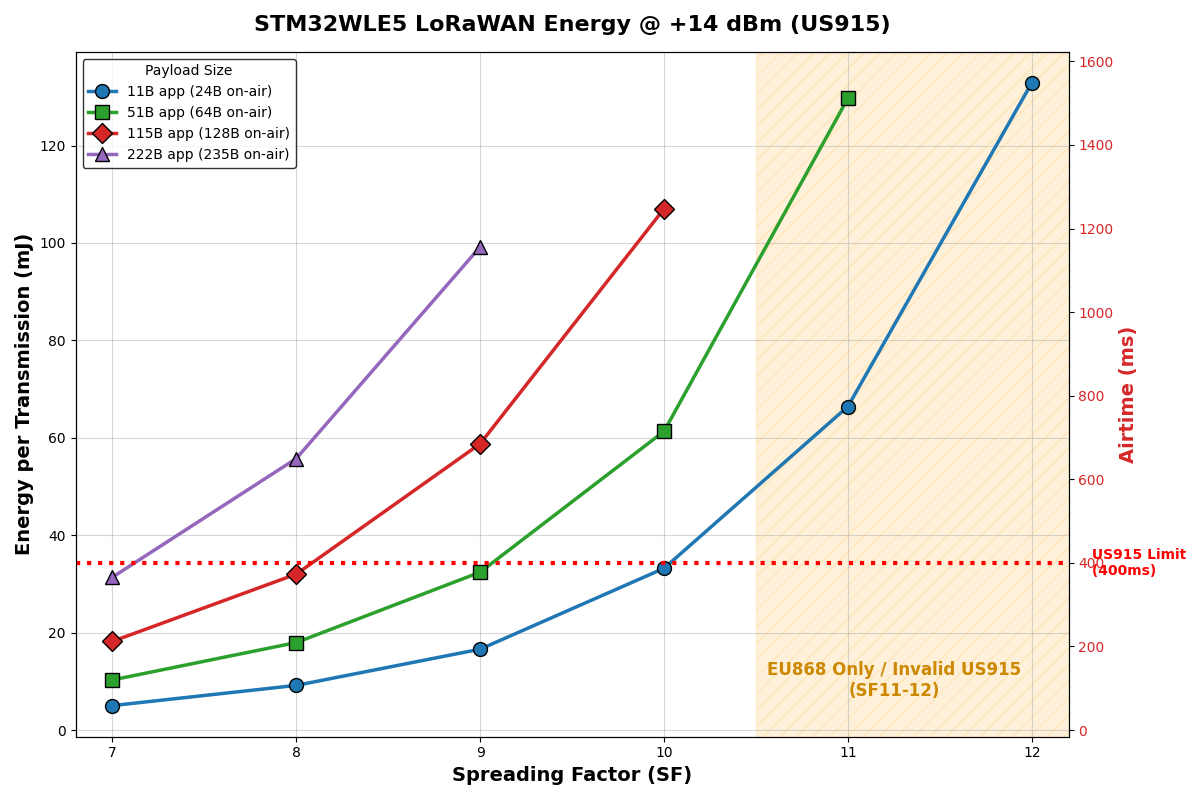
Energy vs Spreading Factor: The Data
STM32WLE5 LoRa radio characterization at +14 dBm, 125 kHz bandwidth, 4/5 coding rate:
| SF | Payload (app) | Payload (total) | Airtime (ms) | Energy (mJ) | US915 Legal |
|---|---|---|---|---|---|
| SF7 | 11 B | 24 B | 59 ms | 5.0 mJ | ✓ |
| SF7 | 51 B | 64 B | 120 ms | 10.3 mJ | ✓ |
| SF7 | 115 B | 128 B | 212 ms | 18.2 mJ | ✓ |
| SF7 | 222 B | 235 B | 366 ms | 31.4 mJ | ✓ |
| SF8 | 11 B | 24 B | 107 ms | 9.2 mJ | ✓ |
| SF8 | 51 B | 64 B | 209 ms | 18.0 mJ | ✓ |
| SF8 | 115 B | 128 B | 373 ms | 32.0 mJ | ✓ |
| SF8 | 222 B | 235 B | 650 ms | 55.8 mJ | ✗ (>400ms) |
| SF9 | 11 B | 24 B | 194 ms | 16.6 mJ | ✓ |
| SF9 | 51 B | 64 B | 378 ms | 32.4 mJ | ✓ |
| SF9 | 115 B | 128 B | 685 ms | 58.8 mJ | ✗ |
| SF10 | 11 B | 24 B | 387 ms | 33.2 mJ | ✓ |
| SF10 | 51 B | 64 B | 715 ms | 61.3 mJ | ✗ |
| SF11 | 11 B | 24 B | 774 ms | 66.4 mJ | ✗ |
| SF12 | 11 B | 24 B | 1548 ms | 132.8 mJ | ✗ |
Key observation: SF7 11-byte packets cost just 5 mJ—that’s 6.6× cheaper than SF10 11-byte packets.
The US915 400ms Constraint
Under US915 regulations, dwell time is limited to 400ms per channel hop. This constrains our options:
Legal combinations (< 400ms airtime):
- SF7: All payloads up to 222 bytes
- SF8: Up to 115 bytes
- SF9: Up to 51 bytes
- SF10: Only 11 bytes (our baseline telemetry packet)
The Stratosonde strategy: Use SF10 with 11-byte packets as the normal mode—maximum range within legal limits, 33.2 mJ per transmission, 387 ms airtime.
Mapping Energy to Temperature Regimes
The cascading power architecture provides different energy budgets at different temperatures:
| Temperature | Power Source | Available Energy | Max SF/Payload |
|---|---|---|---|
| Above -50°C | LTO Battery direct | 100+ mJ | SF10+ any |
| -50°C to -58°C | Supercap buffered | 50+ mJ | SF10 11B |
| -58°C to -63°C | Aluminum polymer | 12.4 mJ | SF7 51B max |
| Below -63°C | Ceramic bank | 12.4 mJ | SF7 11B only |
The critical insight: Below -58°C, we can no longer afford SF10 transmissions. The aluminum polymer capacitor can deliver 12.4 mJ—enough for SF7 (5-18 mJ) but not SF10 (33+ mJ).
GNSS vs LoRa Ping: The Surprising Tradeoff
Position data is critical for a stratospheric balloon. Two ways to obtain it:
Option 1: GNSS Fix
- Hot fix: 25 mA × 1s = 25 mJ
- Cold fix (ephemeris refresh): 25 mA × 30s = 750 mJ
Option 2: LoRa Beacon (gateway-based localization)
- SF7 11B ping: 26 mA × 59ms = 5 mJ
- Position derived from gateway RSSI/TDOA metadata
The math at extreme cold (-60°C):
- Available energy: 12.4 mJ
- GNSS hot fix: 25 mJ → Not possible
- SF7 ping: 5 mJ → Possible, with margin for 2 pings
From 20km altitude, line-of-sight extends hundreds of kilometers. Even without coordinates in the packet, if any gateway receives the ping, the gateway metadata (location, RSSI, timestamp) provides coarse position data.
Emergency strategy: Skip GNSS entirely, send SF7 beacon pings. Geographic uncertainty increases, but mission continuity is preserved.
Adaptive Transmission Firmware Strategy
Based on energy characterization, the firmware implements temperature-adaptive transmission:
typedef enum {
    TX_MODE_NORMAL,      // SF10, full telemetry, GNSS position
    TX_MODE_DEGRADED,    // SF10, reduced telemetry, GNSS hotfix only
    TX_MODE_EMERGENCY,   // SF7, minimal telemetry, skip GNSS if cold
    TX_MODE_BEACON       // SF7, position ping only, no GNSS
} TransmissionMode_t;

TransmissionMode_t GetTransmissionMode(int8_t temperature_C, uint16_t voltage_mV) {
    // Check both temperature and voltage under load
    if (temperature_C > -50 && voltage_mV > 4000) {
        return TX_MODE_NORMAL;
    } else if (temperature_C > -58 && voltage_mV > 3500) {
        return TX_MODE_DEGRADED;
    } else if (temperature_C > -63 && voltage_mV > 2500) {
        return TX_MODE_EMERGENCY;
    } else {
        return TX_MODE_BEACON;
    }
}
Mode Details
TX_MODE_NORMAL (Above -50°C)
- SF10, 11-byte packet: 33.2 mJ
- Full GNSS fix: 25 mJ hot, up to 750 mJ cold
- Total: 58-783 mJ per cycle
- Energy available: 100+ mJ (LTO direct)
TX_MODE_DEGRADED (-50°C to -58°C)
- SF10, 11-byte packet: 33.2 mJ
- GNSS hotfix only: 25 mJ (skip if no cached ephemeris)
- Total: 33-58 mJ per cycle
- Energy available: 50+ mJ (supercap buffered)
TX_MODE_EMERGENCY (-58°C to -63°C)
- SF7, 11-byte packet: 5.0 mJ
- GNSS hotfix if cached: 25 mJ (skip if unavailable)
- Total: 5-30 mJ per cycle
- Energy available: 12.4 mJ (aluminum polymer)
- Note: May need to skip GNSS, use cached position
TX_MODE_BEACON (Below -63°C)
- SF7, minimal ping: 5.0 mJ
- No GNSS (cannot afford)
- Total: 5 mJ per cycle
- Energy available: 12.4 mJ (ceramic bank, barely)
- Position: Gateway metadata only
Transmission Interval Scaling
When energy becomes constrained, extend the transmission interval:
| Mode | Interval | Rationale |
|---|---|---|
| Normal | 5 min | Full solar recharge between transmissions |
| Degraded | 10 min | Allow supercap full recharge |
| Emergency | 15 min | Allow aluminum polymer recovery through cold battery |
| Beacon | 30 min | Maximum conservation, ceramic bank takes time to charge |
At 30-minute intervals in beacon mode, a 5 mJ ping represents just 2.8 µW average power—the system could theoretically operate indefinitely on any trickle current.
The Complete Energy Flow
Tying together the cascading power architecture and LoRaWAN energy budget:
Solar Panel (50-100 mW daytime)
        ↓
BQ25570 Energy Harvester (70% efficiency)
        ↓
2S LTO Battery (40 mAh × 4.8V = 691 J total)
        ↓ (above -50°C: direct)
        ↓ (below -50°C: trickle charge)
        ↓
1.5F Supercapacitor (50+ mJ per burst)
        ↓ (below -58°C: trickle charge)
        ↓
3300µF Aluminum Polymer (12.4 mJ per burst)
        ↓ (below -63°C: trickle charge)
        ↓
1.32mF Ceramic Bank (12.4 mJ per burst)
        ↓
Buck Converter (85% efficiency)
        ↓
3.3V Rail → STM32WLE5 → LoRa Radio

Energy delivered to RF transmission:
- Normal mode: 33.2 mJ (SF10 11B)
- Emergency mode: 5.0 mJ (SF7 11B)
The cascade match: The ceramic bank’s 12.4 mJ capacity is precisely sized for SF7 11-byte transmissions (5 mJ) with 2.5× margin—enough for the buck converter losses and some MCU processing overhead.
Batch Transmission Strategy
The firmware implements intelligent batching to maximize data throughput:
Normal operation (plenty of energy):
- Send latest telemetry confirmed @ SF10 → Wait for ACK
- If ACK: Send N packets unconfirmed @ SF10 → No wait
- Send oldest unsent packet confirmed @ SF10 → Verify link still up
Energy-constrained operation:
- Send latest telemetry unconfirmed @ SF7 → Save ACK energy
- Queue additional packets in flash for later transmission
- When conditions improve: Burst upload queued data
The confirmed/unconfirmed tradeoff:
- Confirmed: Must wait for RX windows → More time at full power
- Unconfirmed: Fire and forget → Minimum energy, no delivery guarantee
At extreme cold, unconfirmed SF7 pings maximize the probability of some data getting through rather than guaranteed delivery of nothing.
Power Budget Summary
Putting it all together for a typical 24-hour period at altitude:
| Phase | Duration | Mode | Energy/TX | Interval | TX Count | Total Energy |
|---|---|---|---|---|---|---|
| Day, warm | 6 hr | Normal | 58 mJ | 5 min | 72 | 4.2 J |
| Day, cold | 6 hr | Degraded | 33 mJ | 10 min | 36 | 1.2 J |
| Night, cold | 6 hr | Emergency | 5 mJ | 15 min | 24 | 0.12 J |
| Night, extreme | 6 hr | Beacon | 5 mJ | 30 min | 12 | 0.06 J |
| Total | 24 hr | — | — | — | 144 | 5.58 J |
LTO battery capacity: 691 J (at room temperature) Solar harvest (daytime, 6 hr at 50 mW avg, 70% eff): 756 J
Energy balance: +750 J harvested − 5.58 J transmitted = positive margin
The system is solar-positive during any day with reasonable sunshine, with enough battery reserve for multi-day nighttime or cloudy operation.
Conclusion: The SF7 Lifeline
The key insight from this analysis: SF7 is the stratospheric survival mode.
- SF10 provides range and reliability when energy is plentiful
- SF7 provides mission continuity when energy is scarce
- The 6.6× energy reduction (33.2 mJ → 5 mJ) matches the cascade power degradation
At -60°C, when the battery can barely deliver 25 mA and the supercap has frozen solid, those 5 millijoules from the aluminum polymer capacitor can still push a ping out to space. And from 20km altitude, line-of-sight to gateways hundreds of kilometers away makes even low-power SF7 viable.
The firmware ties it together: monitor temperature and voltage, adapt SF automatically, and keep transmitting until the physics says stop.
Design for SF10 performance. Plan for SF7 survival.
Related Posts
This post completes the Stratosonde power system characterization series:
- HTC1015 LTO Temperature Characterization - Battery performance at extreme cold
- BQ25570 Bench Characterization - Solar harvester efficiency
- Stratosonde Cascading Power Architecture - The multi-layer power design
- Ceramic Capacitor Bank Validation - Ceramic layer at -70°C
- Aluminum Polymer Capacitor Integration - Bridge layer characterization
LoRaWAN parameters: STM32WLE5 integrated radio, +14 dBm TX power, 125 kHz bandwidth, 4/5 coding rate, US915 frequency plan.
Raw energy data: lorawan_energy_data.csv